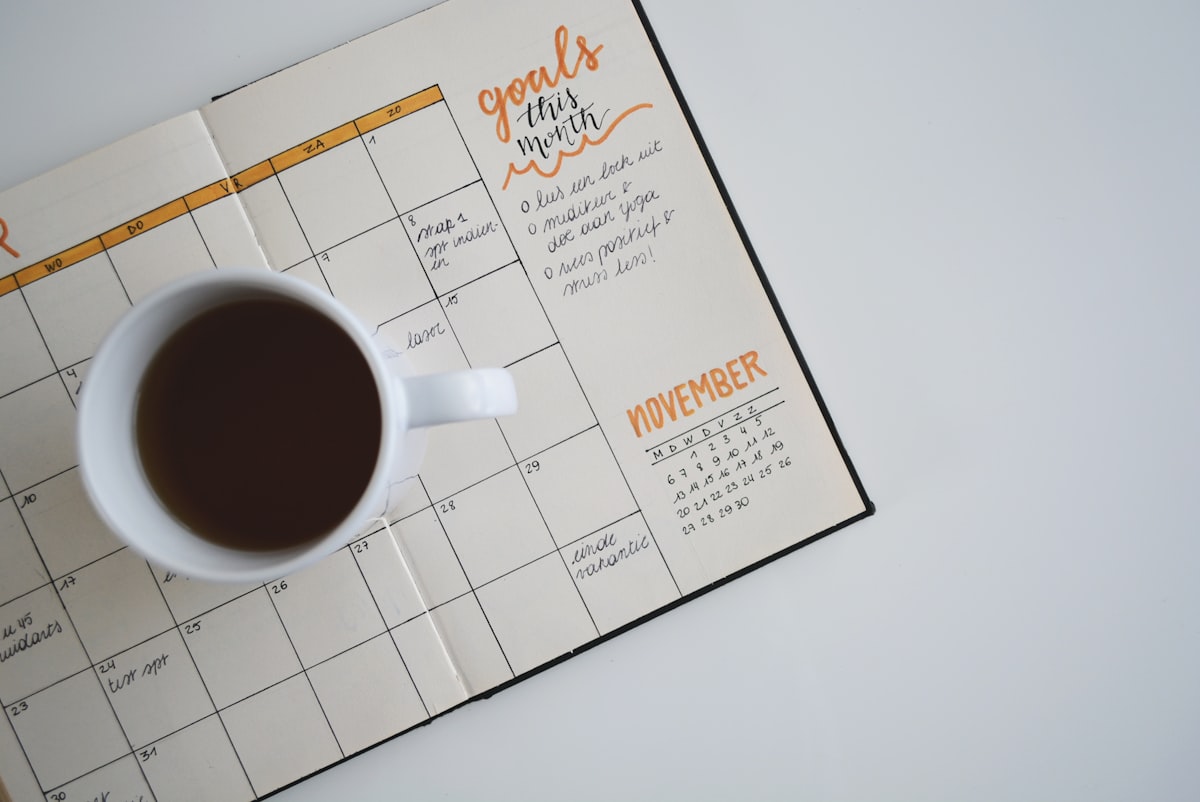
Most people who try to keep a notebook abandon it within weeks because they expect perfection: uniform handwriting, chronological order, color-coded categories, indexed sections. The practical alternative is simpler: a single notebook where tasks, observations, and ideas live together in the order they occur, with enough structure to find what you need but not so much that the system becomes a second job.
Why a single notebook works better than multiple systems
The friction of choosing which notebook to open—work journal, task list, idea capture, daily log—defeats the purpose. When you're in a meeting and need to write something down, or at home and remember a task, reaching for one familiar notebook is faster than deciding which specialized system to use. A unified space also reveals patterns that separate systems hide: you might notice that tasks cluster around certain times, or that observations lead to actionable ideas. The cost is minimal. A regular spiral or bound notebook works fine; ruled or blank paper is personal preference. The goal is consistency, not elegance.
What should actually go in?
Treat the notebook as a capture tool, not a final archive. Write down tasks before they slip away, meetings while details are fresh, observations that might be useful later, quick sketches or diagrams if they clarify something, contact information, URLs, quotes, decisions made. The only rule is: if you think you might need it later and your memory is unreliable, write it down now. Don't worry about format. A task can be a sentence or a checkbox. A date can be at the top of a page or skipped entirely if entries are dense enough to remember context later. The notebook's job is to externalize your thinking, not to perform.
How much structure is actually necessary?: Minimal and Entries
Minimal. Date your entries—even just a weekday name—so you can estimate when something happened. Leave some white space between sections (a task list, then a meeting note, then an idea) so your eye can find natural boundaries when you flip back. If you work across projects or contexts, a one-word label at the start of a section takes three seconds and helps you locate things later: "Project X," "Meeting: Sarah," "Home," "Thinking." That's enough. Resist the urge to create an index until you have several months of entries and genuinely can't find something. At that point, write page numbers on the spine and add a quick index on the back inside cover. Backfilling an elaborate system before you need it wastes time now and wastes time later when you don't follow the system anyway.
How do you actually review and act on what you wrote?
Decide on a cadence before you start: once a week, flip backward through the past seven days and move any incomplete tasks to a next-actions list (which can be on a single page you keep updating, or in your digital calendar if deadlines matter). Circle or mark items you want to remember. That's it. You don't need a formal review system. The notebook serves its purpose when you can find the phone number, task, or decision you wrote down six weeks ago in under a minute. If you're spending more than a few minutes per week maintaining the system, you've overbuilt it.
What about digital versus analog?
Handwriting forces you to summarize, which strengthens memory. Typing is faster when speed matters most. Some people use a physical notebook for mornings and thinking, then sync critical items to a digital task manager. Others keep everything analog and photograph pages for backup. Neither approach is wrong. The deciding factor is your own behavior: will you actually open the notebook, or will you default to your phone? Paper notebooks sit visible on your desk and interrupt you to notice them. Apps require launching. Choose based on what you'll reliably use, not on what efficiency theory says you should use.
When should you start a new notebook?
When the pages run out or when the notebook feels too full to open without dread. If you fill a notebook in three months, that's fine. If it takes a year, also fine. Some people keep old notebooks in a shelf and reference them occasionally; most people never look back and that's also acceptable. The notebook's value is in the act of recording and the first few reviews, not in creating a permanent archive. Treat each filled notebook as complete and move to the next one without guilt. You captured what you needed when you needed it. That was the goal, and you achieved it.
A practical notebook succeeds when you use it without thinking about the system. Test your approach after two weeks: Can you find recent entries quickly? Do you actually write in it daily? Does maintaining it feel like a chore? If yes to the first two and no to the third, you've found the right balance. If the system is weighing you down, strip it down further. The notebook that gets used is infinitely more valuable than the perfect notebook you stop opening.